
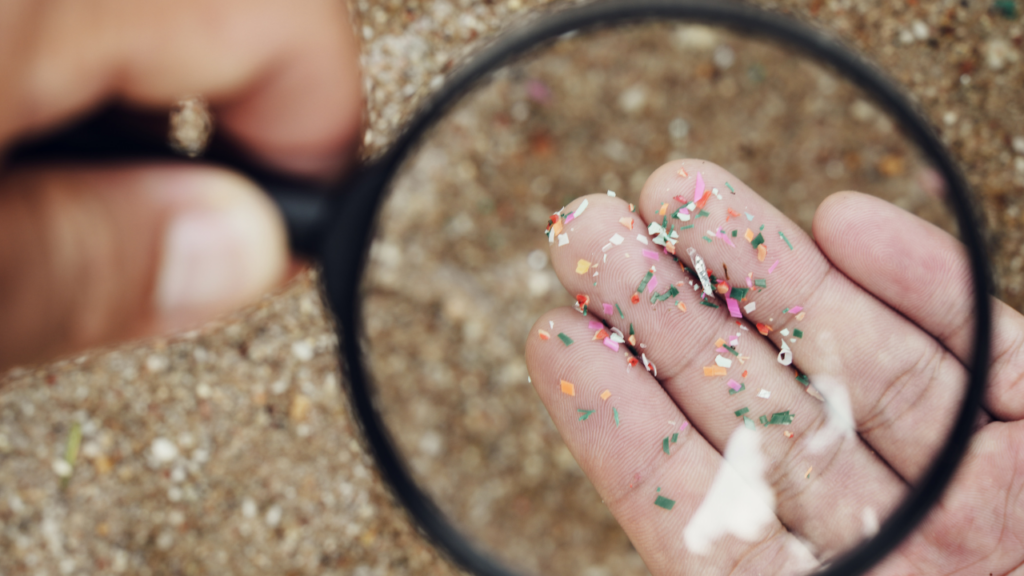
For years, landscapers have warned clients about compacted soil, heat islands, invasive species, and irrigation waste. But in 2026, a new issue has quietly moved to the front of the line—an issue most people in the landscaping world would prefer not to acknowledge at all:
Microplastics are now showing up in garden beds, tree pits, bioswales, and rooftop planters across New York.
Mulch—yes, the stuff we spread everywhere to “improve” landscapes—has become one of the biggest unregulated sources.
As ecological landscapers in New York, we see it firsthand. Plastic fragments from shredded bags, synthetic turf fibers, landscape weed membranes, construction debris, and even airborne tire dust now accumulate in soil faster than plants or microbes can break them down [1]. And because mulch is often processed from urban wood waste or packaged in plastic, it’s becoming a direct delivery system for microplastic pollution.
This isn’t alarmist—it’s simply what the soil is showing us.
And the more we dig, the clearer it becomes: microplastics are reshaping the ecology under our feet.
Why Microplastics in Landscaping Have Become a 2026 Issue
Microplastics aren’t new. But their concentration in urban soils has reached a point where they now influence:
- Root development
- Soil microbial communities
- Water infiltration and retention
- Soil structure
- Plant nutrient uptake
- Long-term ecological function
The combination of NYC’s density + landscaping trends + construction practices creates the perfect storm.
Let’s break it down.
1. Mulch Itself Is Often Contaminated
This is the part nobody likes to admit.
Mulch—especially inexpensive, bulk, or dyed mulch—often comes from mixed urban waste streams. That means:
- Shredded pallets containing plastic nails, straps, or coatings
- Wood processed alongside packaging waste
- Plastic fragments from contaminated loads
- Mulch stored or transported in torn plastic bags
- Recycled “urban wood chips” with small plastic inclusions
In 2026, it’s becoming increasingly common to find:
- Blue and white specks from plastic wrapping
- Thin-film fragments from bagged mulch
- Synthetic fiber threads from packaging twine
- Traces of plastic labels
Eco Brooklyn’s crews see this in brownstone yards, tree beds, rooftop gardens, and bioswales—especially after mulch decomposes for a year or two.
When the organic matter breaks down, the plastic remains.
2. Synthetic Turf Is Breaking Down Faster Than Expected
Many NYC properties installed artificial turf over the past 15 years. By 2026, that first generation of turf is failing.
What we’re seeing:
- UV exposure makes synthetic blades brittle
- Foot traffic grinds fibers into dust
- Crumb rubber migrates into nearby soil [2]
- Infill materials clog planters and drainage zones
- Wind carries plastic fragments into garden beds
Even properties with only small patches of turf see contamination spreading into adjacent mulch.
For green wall installers and landscapers in New York, this is now a real maintenance issue: synthetic turf breakdown contaminates soils that were never meant to hold plastics.
3. Tire Dust: The Invisible Microplastic Source
New York has millions of daily vehicle trips. Tire wear releases synthetic rubber dust that:
- Settles on sidewalks
- Washes into curbside plantings
- Enters bioswales during storms
- Accumulates in rooftop drains and planter edges
- Blows into backyards
Tire dust is rich in metals, polymers, and carbon black—none of which belong in soil [3].
Bioswales designed for green infrastructure end up catching these particles, meaning the most ecological installations often receive the most contamination.
4. Landscape Fabric Creates Microplastics as It Ages
Weed barrier fabrics were marketed as a maintenance miracle. But in practice, the woven polypropylene breaks down into microplastic threads.
By the time you see a fabric disintegrating, it has already released thousands of fragments [4].
5. Construction Sites Are a Direct Source
NYC landscaping rarely happens in isolation. You’re usually working next to a renovation, brownstone rebuild, sidewalk project, or utility trench.
Those sites generate:
- Plastic sheeting scraps
- Foam insulation particles
- PVC sawdust
- Packaging films
- Zip-tie fragments
- Microbeads from cutting tools
One windy day, and it’s in your planting bed.
How Microplastics Affect Soil and Plants
Microplastics don’t behave like typical soil particles. They disrupt every layer of the soil ecosystem.
1. Soil Structure Changes
Plastic fragments alter:
- Pore spaces
- Water-holding capacity
- Drainage behavior
Some soils become hydrophobic. Others retain water too long [5]. Both create stress for plants.
2. Roots Grow Around Plastic Instead of Through Soil
Roots detour around plastic fragments, creating weaker anchoring networks [6].
In Eco Brooklyn’s soil assessments, we’ve found root tips wrapped around plastic fibers like vines around wire.
3. Microbial Communities Shift
Bacteria colonize plastic surfaces easily. Fungi do not [7].
This pushes soils toward bacterial dominance—problematic for:
- Woodland natives
- Fungal-dependent shrubs
- Mycorrhizal species
- Ferns
- Ecological restoration plantings
4. Nutrient Cycling Slows Down
Microplastics interfere with:
- Soil aggregation
- Decomposition
- Mycorrhizal nutrient transfer
Over time, soils get “tired” and need more amendments to stay ecological [8].
5. Stormwater Performance Declines
Bioswales with high microplastic loads:
- Infiltrate water more slowly
- Lose organic matter faster
- Clog underdrains
- Accumulate pollutants on polymer surfaces
This is a concern for NYC’s green infrastructure installations [9].
So, What Do We Do? Eco Brooklyn’s 2026 Strategies
Unlike many landscape firms, Eco Brooklyn treats microplastic contamination as a design problem—not an unfortunate inevitability.
Here’s how we address it:
1. Ultra-Clean Mulch Sources
We source:
- Arborist chips directly from tree work
- Untreated, un-dyed wood
- Mulch delivered in bulk without plastic bags
- Regionally chipped wood from brush, not pallets
We also visually screen loads for contamination.
2. Anti-Synthetic Turf Policy
We no longer install turf in ecological landscapes.
And when clients insist?
We create separation zones and barrier layers to prevent microplastic migration.
3. No Landscape Fabric, Ever
Instead, we use:
- Thick wood chip layers
- Living groundcovers
- High-fungal mulches
- Soil shading strategies
These prevent weeds without shedding polypropylene.
4. Wind and Storm Management in Urban Sites
We design for the realities of NYC:
- Wind traps
- Perimeter plantings
- Low-profile beds near streets
- Filter strips for tire dust
- Sediment forebays in bioswales
These reduce how much airborne plastic reaches soil.
5. Soil Testing & Microplastic Monitoring
We regularly check soil for:
- Visible plastic fragments
- Fiber accumulation
- Drainage anomalies
- Soil aggregation issues
When needed, we remove contaminated upper layers and rebuild ecological soil horizons.
6. Planting Designs That Resist Microplastic Stress
Some species tolerate contaminated soils better.
We specify plants with:
- Strong root plasticity
- High fungal adaptability
- Deep anchoring networks
- Resilience to hydrology changes
For sensitive plantings, we isolate root zones entirely.
Why This Matters for Landscaping in New York
NYC is a global microplastic hotspot—thanks to traffic, density, construction, and aging infrastructure.
Landscaping in New York means designing for:
- Pollutants
- Heat islands
- Stormwater surges
- Soil compaction
- And now, microplastic accumulation
The sooner we integrate microplastic mitigation into ecological design, the more resilient our landscapes will become.
Clients increasingly want “sustainable landscaping” and “ecological landscaping in NYC.” They’re asking smarter questions. Microplastic solutions will be a major part of the conversation in 2026 and beyond.
Designing for the City We Actually Live In
Microplastics weren’t on anyone’s radar a decade ago.
But today, they’re everywhere: in street tree pits, backyard beds, rooftop gardens, bioswales, and green walls.
This isn’t a problem we can mulch over.
It’s a soil-level challenge that demands soil-level solutions.
Eco Brooklyn’s approach is simple:
Design with clean materials. Protect the soil. Build systems that resist contamination.
Because a landscape can’t be ecological if the soil beneath it is quietly filling up with plastic.
Contact us today to start designing a resilient, low-impact outdoor landscape in NYC.
References –
[1] Rillig, M. C. (2012). Microplastic in terrestrial ecosystems and the soil? Environmental Science & Technology, 46(12), 6453–6454. https://doi.org/10.1021/es302011r
[2] Magnusson, K., Eliaeson, K., Fråne, A., Haikonen, K., Hulténius, U., Olshammar, M., Stadmark, J., & Voisin, A. (2016). Swedish sources and pathways for microplastics to the marine environment. Swedish Environmental Protection Agency.
[3] Kole, P. J., Löhr, A. J., Van Belleghem, F. G. A. J., & Ragas, A. M. J. (2017). Wear and tear of tyres: A stealthy source of microplastics in the environment. International Journal of Environmental Research and Public Health, 14(10), 1265. https://doi.org/10.3390/ijerph14101265
[4] Steinmetz, Z., Wollmann, C., Schaefer, M., Buchmann, C., David, J., Tröger, J., Muñoz, K., Frör, O., & Schaumann, G. E. (2016). Plastic mulching in agriculture. Trading short-term agronomic benefits for long-term soil degradation? Science of the Total Environment, 550, 690–705. https://doi.org/10.1016/j.scitotenv.2016.01.153
[5] de Souza Machado, A. A., Kloas, W., Zarfl, C., Hempel, S., & Rillig, M. C. (2018). Microplastics as an emerging threat to terrestrial ecosystems. Global Change Biology, 24(4), 1405–1416. https://doi.org/10.1111/gcb.14020
[6] Boots, B., Russell, C. W., & Green, D. S. (2019). Effects of microplastics in soil ecosystems: Above and below ground. Environmental Science & Technology, 53(19), 11496–11506. https://doi.org/10.1021/acs.est.9b03304
[7] Rillig, M. C., Ingraffia, R., & de Souza Machado, A. A. (2017). Microplastic incorporation into soil in agroecosystems. Frontiers in Plant Science, 8, 1805. https://doi.org/10.3389/fpls.2017.01805
[8] Qi, Y., Yang, X., Pelaez, A. M., Lwanga, E. H., Beriot, N., Gertsen, H., Garbeva, P., & Geissen, V. (2018). Macro- and micro- plastics in soil-plant system: Effects of plastic mulch film residues on wheat (Triticum aestivum) growth. Science of the Total Environment, 645, 1048–1056. https://doi.org/10.1016/j.scitotenv.2018.07.229
[9] Liu, M., Lu, S., Song, Y., Lei, L., Hu, J., Lv, W., Zhou, W., Cao, C., Shi, H., Yang, X., & He, D. (2018). Microplastic and mesoplastic pollution in farmland soils in suburbs of Shanghai, China. Environmental Pollution, 242(Pt A), 855–862. https://doi.org/10.1016/j.envpol.2018.07.051