
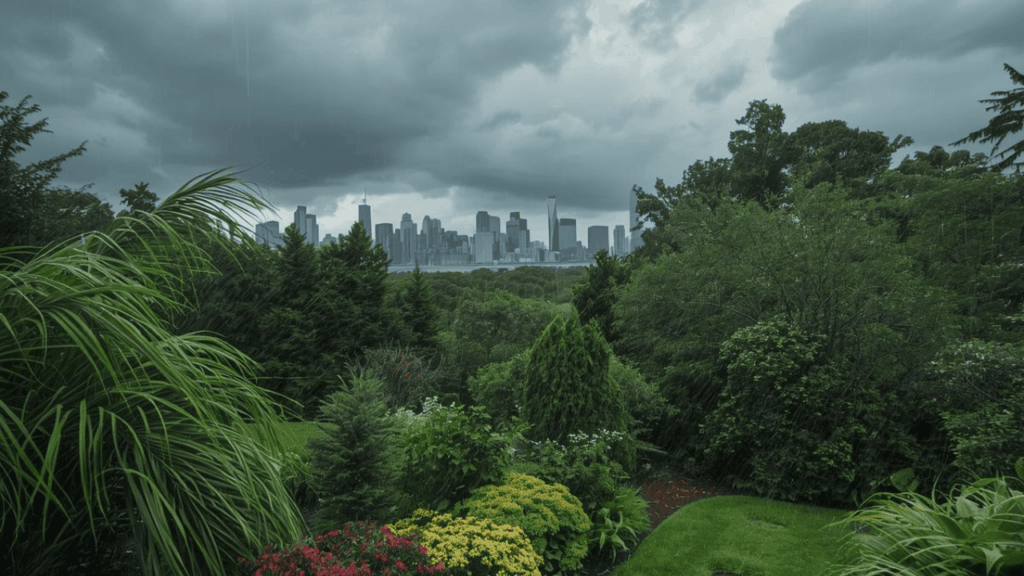
Hurricanes are no longer rare events on the Atlantic coast—they’re recurring stress tests for cities like New York. While names like Sandy and Ida are etched into memory for their destruction, the real lesson they’ve left behind isn’t only about seawalls or emergency drains—it’s about how we design and maintain our urban landscapes in New York.
As professional landscapers and ecological designers in New York, we must now think of green infrastructure as a climate defense system.
This article explores how New York’s urban landscapes can be reimagined to withstand hurricanes—through smarter soil systems, decentralized drainage, and ecological design thinking.
The Urban Flood Problem Isn’t Going Away
Research confirms that Atlantic hurricane seasons are showing elevated activity and persistent storm conditions [1].
In New York City, large-scale rainfall events overtopped drainage systems and challenged existing infrastructure—a reminder that traditional “gray” stormwater systems face increasing pressure.
Why New York Landscapers Are Now Climate Engineers
Green infrastructure—bioswales, green roofs, rain gardens, retention landscapes—plays an important role in urban stormwater management and resilience [2].
At Eco Brooklyn, we’ve seen how retrofitting even small commercial courtyards with rain-capture beds can mitigate flash flooding and protect building foundations. The key is not aesthetics—it’s infiltration rate, soil profile, and overflow planning.
Soil and Plant Systems as Shock Absorbers
Sites across urban contexts with vegetated surfaces and healthier soils show better ability to handle heavy rainfall and runoff dynamics [3].
Sound soil selection and design matter when specifying fill mixes for rooftop planters or bioswales in NYC’s built environment.
The Case for Decentralized Drainage
Citywide storm systems were designed for older rainfall norms. The New York City Department of Environmental Protection’s Cloudburst Resiliency Planning Study highlights the value of deploying distributed green infrastructure—rain gardens, green roofs, detention basins—to address flood risk neighbourhood-by-neighbourhood [4].
For landscape professionals in New York, this means collaborating with civil engineers and planners is no longer optional.
Wind, Salt, and Plant Survival After the Storm
It’s not just water. High winds and salt spray after coastal surges kill many ornamental plantings. Coastal and rooftop environments face stressors including salt spray and elevated wind loads. Designers must select resilient, deep-rooted, tolerant species and plan for ongoing adaptation.
New York Landscape Design Lessons from Ida and Sandy
1. Drainage redundancy is survival. Always design overflow pathways—no system stays perfect.
2. Avoid “sealed” surfaces. Use permeable pavers or vegetated joints.
3. Think vertical and horizontal storage. Combine green roofs with bioswales and detention beds.
4. Test infiltration early. A single clogged underdrain can flood an entire site.
5. Model worst-case rainfall. Ida set a new baseline—design beyond code.
Toward Hurricane-Ready Landscapes in New York
True resilience isn’t about hardening—it’s about adapting. Landscapes that slow, absorb, and filter water; that recover after salt exposure; that rely on diverse plant communities—those are the systems that bounce back.
As climate volatility becomes the norm, the landscaping profession’s role expands: we are infrastructure designers, not decorators.
At Eco Brooklyn, we see every bioswale, rain garden, or green wall as part of New York’s long-term storm-resilience network. Our goal isn’t to resist nature—it’s to design with it.
Consult our NYC landscape design experts to make your next landscape part of New York’s climate-resilient future.
References
[1] National Oceanic and Atmospheric Administration. (2023). 2023 Atlantic hurricane season ranks 4th for most-named storms in a year. https://www.noaa.gov/news-release/2023-atlantic-hurricane-season-ranks-4th-for-most-named-storms-in-year
[2] New York City Department of Environmental Protection. (2017). Cloudburst Resiliency Planning Study. https://www.nyc.gov/assets/dep/downloads/pdf/climate-resiliency/nyc-cloudburst-study.pdf
[3] United States Department of Agriculture Natural Resources Conservation Service. (2022). Inherent Factors Affecting Infiltration. https://www.nrcs.usda.gov/sites/default/files/2022-10/Infiltration.pdf
[4] New York City Department of Environmental Protection. (2022). Cloudburst Management in NYC for Long-Term Resilience. https://www.nyc.gov/assets/dep/downloads/pdf/whats-new/programs-initiatives/cloudburst-management-in-nyc-for-long-term-resilience.pdf