
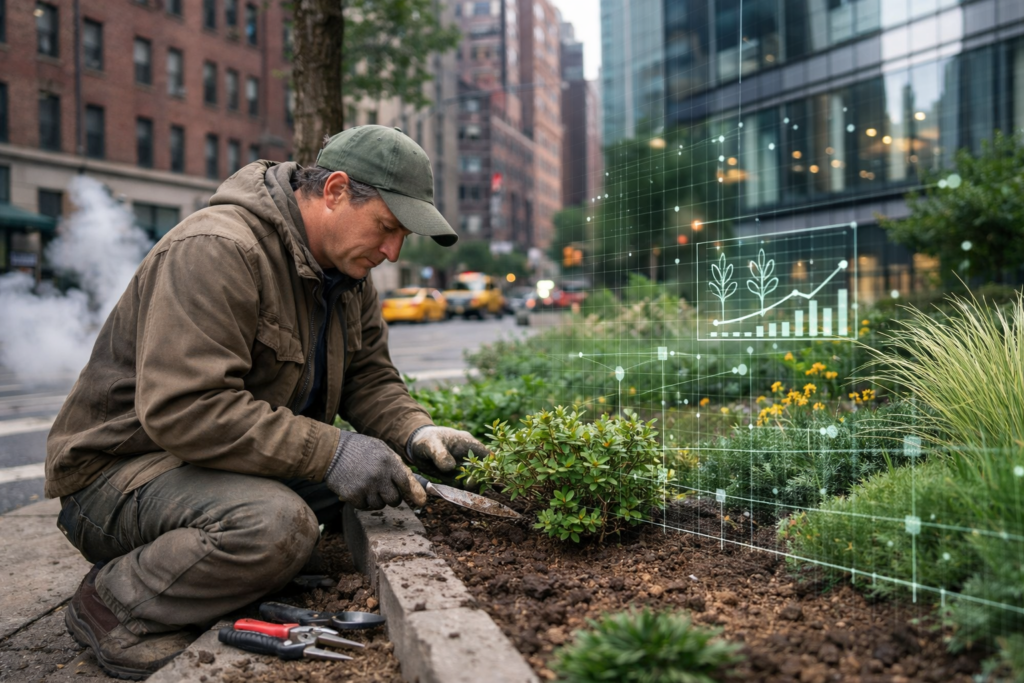
Artificial intelligence is making its way into landscape design, and in many parts of the industry, it is being welcomed with enthusiasm. AI tools can generate planting plans in minutes, simulate sunlight patterns, estimate irrigation needs, and even suggest plant palettes based on climate data. For developers and project teams under pressure to move quickly, the appeal is obvious.
But in New York City, where urban landscapes exist under constant environmental stress, the question is less about speed and more about survival. The real issue is whether AI-designed landscapes can hold up over time, or whether they are more likely to fail once they encounter the realities of the city.
From our perspective, having spent years designing, installing, and retrofitting landscapes across New York, the concern is very real.
Why AI Landscape Design Looks So Convincing on Paper
AI performs well in environments that are measurable and predictable. In landscape design, that includes things like average temperatures, seasonal rainfall, sun exposure, and hardiness zones. These systems can process vast datasets quickly and produce clean, well-organized designs that appear technically sound.
For early-stage planning, AI can be genuinely useful. It helps teams visualize layouts, check compliance with zoning requirements, and develop preliminary plant lists. In controlled environments, or in regions with stable conditions, this approach can work reasonably well.
The problem is that New York City landscaping is not a controlled environment.
The Reality of Urban Landscaping in New York City
Urban landscapes in NYC operate under a unique set of pressures that rarely appear in datasets or design software.
Soils are often heavily compacted or composed of construction fill with little biological activity. Underground steam lines, basements, and transit infrastructure warm the soil year-round, disrupting natural root cycles. Wind patterns created by tall buildings dry out plantings unevenly. Salt from winter de-icing damages roots and foliage. Heat reflects off glass, concrete, and metal surfaces, pushing plants beyond their tolerance thresholds.
On top of that, irrigation systems fail. Drainage performs differently than designed. Maintenance crews change. Budgets tighten.
These are not exceptions. They are normal conditions for commercial and residential landscaping in New York City.
AI tools tend to assume ideal performance across all of these variables. Human designers with field experience do not.
Where AI-Designed Landscapes Start to Break Down
Most AI-designed landscapes are optimized for what should happen rather than what usually does.
Plant selections are often technically appropriate but practically fragile. A species may tolerate a certain temperature range or light level in theory, yet struggle with inconsistent watering, polluted air, compacted soil, or reflected heat. These traits are difficult to quantify and rarely included in algorithmic models.
Experienced landscapers learn this the hard way—by watching certain plants fail repeatedly on real sites. That knowledge is cumulative and contextual. It comes from seeing which species survive year three, not just year one.
AI systems do not yet learn effectively from long-term urban failures. As a result, they tend to repeat the same mistakes, project after project.
Living Walls and Vertical Landscapes: A Higher-Risk Test Case
Living walls, green façades, and vertical gardens present an even greater challenge for AI-driven design.
These systems operate under intensified conditions: limited root volume, increased wind exposure, uneven moisture distribution, and high reliance on mechanical systems. Small miscalculations—plant spacing, irrigation pressure, or species compatibility—can cascade into widespread failure.
We have seen AI-generated living wall designs in New York that were visually elegant but biologically unstable. Plants competed aggressively for limited resources. Upper sections suffered from wind desiccation. Maintenance requirements were underestimated.
Vertical landscapes are not decorative panels. They are living systems under mechanical and environmental stress, and they require judgment that goes beyond data modeling.
Maintenance: The Factor No Algorithm Can Predict
One of the most consistent causes of landscape failure in NYC is not design, but maintenance.
AI assumes maintenance will be regular, skilled, and consistent. In reality, landscape maintenance in New York is shaped by staffing changes, budget constraints, and competing priorities. Even well-written maintenance plans are often only partially followed.
Human designers who have worked in this environment plan accordingly. They select resilient plant species, design redundancy into irrigation systems, and accept that some level of neglect is inevitable. They design landscapes that can survive imperfect care.
AI, by contrast, designs landscapes that require ideal conditions to remain stable.
Why Human Judgment Still Matters in Urban Landscape Design
Human-led landscape design is not about rejecting technology. It is about understanding its limits.
Experienced designers bring something that AI currently cannot: pattern recognition built from years of observation. They understand how microclimates behave on specific blocks, how certain soils respond over time, and how real people interact with designed spaces.
This is particularly important in a city like New York, where landscapes are exposed to constant stress and change. Designing for resilience requires judgment, not just optimization.
A More Realistic Future: AI as a Tool, Not a Decision-Maker
AI will continue to play a role in landscape architecture and urban design. It can support early-stage analysis, improve efficiency, and help teams test scenarios quickly.
But the most successful landscapes, especially in dense urban environments, will come from a hybrid approach. One where AI supports the process, and experienced human designers make the final calls.
Resilient landscaping in New York City depends on designing for reality, not averages.
Eco Brooklyn’s Perspective on AI-Powered Landscaping in NYC
At Eco Brooklyn, we are often brought in to fix landscapes that were beautifully designed but poorly adapted to their environment. On paper, these projects made sense. On the ground, they struggled.
Our approach to urban landscaping in New York prioritizes site observation, soil health, and long-term performance. We use technology where it adds value, but we rely on experience where it matters most. AI can generate plans. Experience keeps landscapes alive.
If your project needs to survive NYC’s heat, wind, soils, and maintenance realities, Eco Brooklyn designs landscapes built for the long term. Reach out to discuss your vision.