About

Eco Brooklyn Inc. is an innovative green contractor and design/build firm in Brooklyn with one simple focus: to Turn Brooklyn Green!
Our background is in green real estate, development, renovation and sustainable energy. We are a team of green builders who are passionate about using old and new technologies to increase the quality of living while reducing costs and benefiting the environment.
We have a wide range of experience and certifications. Education, where we are either students or teachers is a big part of our process. We are constantly increasing our knowledge base as well as educating the community.
We are a certified green roof installer, green real estate broker, radiant floor specialist, green real estate manager, solar thermal installer, Solar PV installer, high efficiency boiler specialist, and green educator.
We focus these skills on building high quality energy efficient structures that last a long time and cost little to build and run. Attention is put on using salvaged, sustainable and local materials.
Eco Brooklyn is fully licensed and insured to do Home Improvement work in the state of NY. Insurance includes: Liability, Disability and Workers Compensation. Liability is up to $2 Million.
Our design skills involve architectural design as well as structural engineering, allowing us to provide the entire service from idea to the final Department of Buildings sign off.
Our design focus is on integrating intelligent green techniques with aesthetic design. We use passive solar strategies that maximize natural heating and cooling as well as visual aesthetics. Our intelligent ventilation techniques, both natural and mechanical, create fresh air homes that are comfortable and healthy.
Our heating design is centered on maximum comfort and minimum cost. Whether it is a split system heat pump, radiant flooring, geothermal, solar thermal, high efficiency boilers or a combination, our heating and cooling systems are precisely fitted for the space and budget.
We specialize in what we call the “green aesthetic” or Wabi-Sabi design, which incorporates a lot of natural materials, from wood to clay, and provides a home that is soothing and invigorating. We combine these elements with attention to the overall Feng Shui of each microcosm and macrocosm in the home.
Overall we see the home as a living being with inner organs, lungs, a skin and a body. We attempt to build the home so that it will remain healthy and happy for many years to come.
As well as doing Brownstone renovations for clients Eco Brooklyn invests in houses and “greens” them. These houses are used as New York community outreach platforms to help train local workers and educate the community in good green building techniques.
We are partnered with local non-profit job training organizations and offer an Eco Brooklyn Green Construction Certification Program for interns wanting to gain work experience in green building. Our interns range from inner city youth at risk and ex convicts to architects and Wall Street types.
Eco Brooklyn’s Director is Gennaro Brooks-Church. Because of his interest for learning he holds several certificates, among them a NY Licensed Real Estate Broker, Certified EcoBroker®, National Sustainable Advisor Program and LEED AP. His real contribution is his passion as an educator, lifetime builder and author of the Build It Forward green building concept.
We adhere to the ethics outlined in our membership with Sustainable Business Network New York City. The ethical sustainable business practices are specified in the triple bottom line – People, Planet, and Profit. Every decision we make considers whether all the people involved, the planet as a whole and the bottom line of everyone involved benefits from the action.
As a continuation to this we build along the Build It Forward criteria where all building must be made to last at least one hundred years, be a desirable gift to future generations and not drain existing resources.
With this strategy we hope to turn Brooklyn green!
We work in the following mediums:
Recycled Flooring and Timber
Radiant Heat
Sustainable Flooring
Fiberglass Windows
Foam Insulation
Solar Water Heating
Geothermal
Solar Electricity
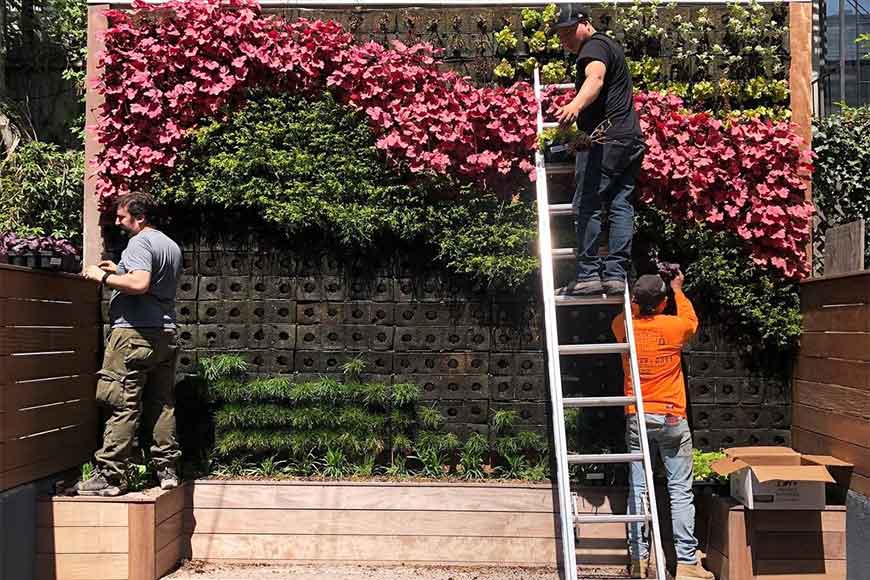
Green Roofs
High Efficiency Boilers
Heat On Demand Boilers
Ecological Counter Tops
Soapstone Fireplaces
Gray Water Recycling
Rain water capture
Edible Gardens
Xeriscape Gardens
We also provide these services:
Architectural Plans
Job Expediting
Energy Tax Rebate Consulting
Energy Audits
Job Management
Green Real Estate Sales and Rentals
Comments
yes you want to lay sheet rock in a staggered way for the following reasons:
the seam is less visible.
the wall or ceiling is held together better.
i’m not sure how important it is to make sure that no seams from the opposite wall line up with seems from the other side. i guess if two seems ran parellel you could have more bridging of heat and sound but not sure if it is that large.
insulation in the wall will stop most of that.

am a new lurker on the Greenbuilder list.
Not sure if its too simple but here goes. A friend from L.A. was talking about old day jobs, Donny is a studio musician now thoroughly expatriated to Germany. His speciality was sheetrock. Talked of the underside of domes, stairways and lots of other things. As he was taught sheetrock was to be put up in overlaping horizonals like bricks. Didn\’t sink in very far to my feeble brain at the time. For special expensive clients he would make sure that there was never more then 1 vertical seam in a line with another. He claimed with this technique the stud lines were less obvious.
I remember reading on dual envelope houses and realised the real concept was to keep the studs from transmitting heat/sound all the way thru the wall. I was recently jarred into realising that even wood in attics will transmit some heat. If the sheet rock was always horizonal there would be less transmission thru the seams as they would either span the studs or only make those tiny pathways up the studs for a short distance. I have torn down sheetrock and noticed that there are always voids in the seams. The mud seldom goes more then halfway into the seam. Donny the muscian even did something with multiple layers of thin sheet rock to decrease the transmission of sound. He had build numerous studios that way in his continuing 50 career as a rock an roll musician
You struck me as the only one who might have backround in sheet rock. I am willing to bet that even the sheetrock seams will show up brilliantly to an infrared camera. My house project is in Texas circa 1965 and carefully enlarged without the benifit of any building code by guaranteed non professionals. Has driven the electricians mad and they thought the 50% aluminum wiring was the only problem. The plumbing is finally fixed up with enough ball valves to fix anything that could ever break without drivng my experienced plumber, plumbing inspector totally insane. IT was a great price for the house on the two lots and will be nice after the new double panes and siding are completed and I can start on air leaks. Exact north-south exposure with plenty of wind. Its 45 minutes from downtown Austin but basically a waterless house on the top of a mountain.( waterwell coop is non potable water and closed to additional members) There is enough rain to take collect from the roofs for our retirement but not enough to mist the roof to cool it. I am there 3 months a year and then back to the Alps til my wife retires. Definitely a contrast. Lots of masonry and masonry stoves in these parts. And the locals here in Garmisch wanna know how Americans can live without roladens. I said remember these are people that think enclosed hub brakes and 7 speed internal hubs on bicycles are new and high tech! [both are more maintence free then anything I have ever seen on bicycles]
Anyway if you know anything about the history of sheet rock and wether it was supposed to be hung that way let me know.